Today is Canada Day.
Like many Canadians, I’ve been following Canada’s run at the World Cup with a lot of interest. What impresses me most isn’t simply that they’ve reached the Round of 16. It’s how they’ve done it.
Starting centre back Moïse Bombito had just returned to the lineup from a broken leg when midfielder and offensive engine Ismaël Koné broke his leg in a fierce tackle vs. Qatar. Midfielder Marcelo Flores is out for the tournament with a torn ACL. And of course, their captain Alphonso Davies missed the entire group stage before coming on late against South Africa.
With an injury list like that, for most teams, that’s when expectations begin to fall. Fans lower the bar. Analysts start talking about “next time.” Instead, this team has continued to compete by adapting. They’ve adjusted tactics, other players have stepped into bigger roles, and they’ve found new ways to create scoring opportunities. The objective hasn’t changed. Only the path has.
That struck me because I think great businesses operate exactly the same way.
Business rarely goes according to plan
Every January, business owners sit down and map out their goals for the year. They establish priorities, set budgets, and create plans that make perfect sense based on the information they have at the time.
Then reality shows up.
A key employee resigns. A major customer leaves. A supplier misses deadlines. A competitor drops prices. AI changes your industry faster than anyone expected. Interest rates move. Regulations change. Markets shift.
The businesses that succeed aren’t necessarily the ones that avoid these disruptions. They’re the ones that respond to them without losing sight of where they’re trying to go.
Too many businesses confuse a change in circumstances with a reason to abandon the plan altogether. But your destination and your route are two very different things.
Don’t confuse the goal with the game plan
One of the ideas I come back to repeatedly with clients is that your Big Picture shouldn’t change every time life throws you a curveball.
If your vision is to build a business that creates meaningful profit, impact, and enjoyment, that vision doesn’t suddenly become the wrong vision because you lose a great employee or a new competitor opens across town. Your quarterly priorities may change. Your tactics may change. Your timeline may even change.
But the destination stays the same.
Canada didn’t stop trying to win because the lineup changed. They changed the lineup.
Adaptability isn’t luck
Watching Canada’s World Cup run reminded me that adaptability isn’t something teams magically discover halfway through a tournament. It comes from years of preparation, coaching, communication, and having players who understand the system they’re playing within.
The same is true in business.
When a key employee leaves and everything falls apart, that’s usually not a people problem. When one supplier misses a delivery and operations grind to a halt, that’s rarely just a supplier problem. More often than not, it’s a systems problem.
Businesses that adapt well tend to have clear ownership, well-defined processes, useful metrics, regular communication, and a rhythm for making decisions. Those things don’t eliminate surprises, but they do make surprises far less disruptive.
In other words, they build resilience before they need it.
That’s what operating frameworks are for
Sometimes people assume that business operating systems exist primarily to help companies grow faster. Growth is certainly one outcome, but I don’t think it’s the biggest one.
The greatest value of an operating framework is that it helps a business adapt without descending into chaos. It gives leaders a common language, a repeatable decision-making process, and the discipline to adjust course without losing momentum.
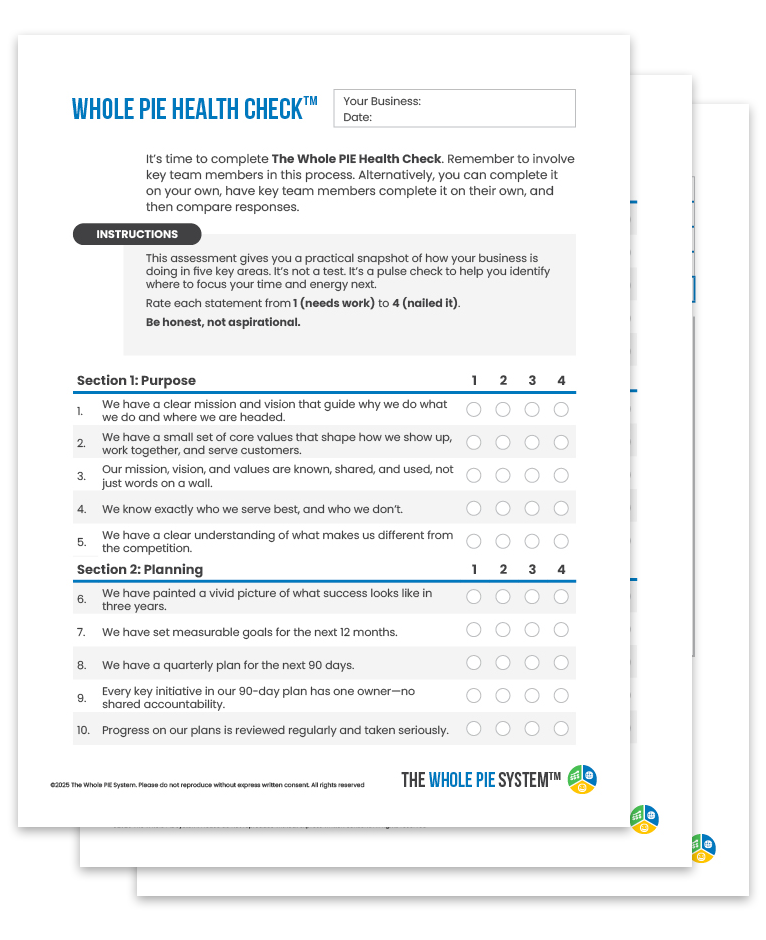
That’s one of the reasons I built The Whole PIE System. It’s not designed to help businesses avoid change. It’s designed to help them navigate change.
Because in business, just like in sport, the winners are rarely the teams that execute the original game plan perfectly. They’re the ones that recognize what’s changed, adjust quickly, and keep moving toward the same goal.
This Week’s Challenge
At your next leadership meeting, ask one simple question:
If our biggest competitor changed their pricing, marketing, or technology tomorrow, how long would it take us to respond?
Then ask a second question that might be even more important:
What’s stopping us from responding faster?
The answers will tell you a lot about whether your business is built to react… or built to adapt.