Five years ago, I could never have imagined that a principle I’d read in a business article years earlier would eventually contribute to my wife and me packing up our lives, taking our four kids, and moving from Canada to Costa Rica.
The principle was about core values. And specifically, what happens when the world around you changes in a way that puts those values to the test.
Years earlier, I’d read an article by Jim Collins and Jerry Porras, authors of Built to Last, about building a company’s vision. They described core values as an organization’s essential and enduring beliefs—values it would continue to hold “even if they became a competitive disadvantage.”
Think about what that means.
It’s easy to call something a core value when there’s no price attached to it. But what happens when holding that value costs you money, an opportunity, a customer, a relationship—or something else you care about? Would you still hold it?
I had always thought that was a powerful business idea.
In 2021, it became intensely personal.
When your values and the world around you collide
One of my deepest personal values has always been freedom. That includes time freedom, financial freedom, freedom of speech, the freedom to choose how I live, and the freedom to make important decisions, such as medical decisions, for myself and my family.
Freedom has also influenced my work. I’ve always believed that one of the purposes of building a great business is to create more freedom—for owners, employees, customers and the people whose lives that business touches.
Then Covid arrived.
Like everyone else, our family lived through lockdowns, restrictions, school and business closures, and all the uncertainty of that first year of Covid. Everyone was in it together.
Then came the mandates, which turned communities into us versus them. The togetherness disappeared. Starting in August and September of 2021, whether or not you’d taken the jabs began affecting access to employment, public spaces, and participation in sports or other activities, even for kids.
That was five years ago. How our lives have changed since.
People had—and still have—very different views about whether those measures were appropriate or necessary. There’s no sense trying to resolve those differences here. What matters to this story is that the mandates collided head-on with one of our family’s core values.
My wife and I believe that decisions about whether we or our children received a particular medical intervention belonged to us. That we get to choose what does and does not go into our bodies, free from coercion or outside pressure. When the mandates arrived, suddenly freedom—in particular medical freedom—wasn’t an abstract word on a list of values. There was a price attached to it.
And that’s when that Collins and Porras article came back to me.
Change your values—or change your circumstances?
In discussing how companies should think about values that are genuinely core values, Collins and Porras wrote:
“A company should not change its core values in response to market changes; rather, it should change markets, if necessary, to remain true to its core values.”
For our family, that business idea became surprisingly literal. We could remain where we were and accept circumstances that increasingly felt inconsistent with how we wanted to live, or we could change our circumstances.
We chose the latter.
In October 2021, our family decided to change markets. We packed up, took our four kids, and travelled around Mexico and Costa Rica for five months. We had left Canada’s mandates behind in exchange for more welcoming cultures in Central America that were more interested in who we were than in something we didn’t do. By April of 2022, we had decided to make a move to Costa Rica permanent.
You don’t have to agree with us
This is probably worth saying explicitly.
You may have looked at exactly the same circumstances and made a completely different decision than we did. You may have supported the mandates. You may have made a different risk-benefit calculation for yourself or your children. You may think moving to another country because of it all was an enormous overreaction.
That’s okay.
Because this isn’t really a story about whether our values were the right values. It’s about whether we were willing to live by them when doing so became difficult.
And that’s a question that applies just as much to a business as it does to a family.
Values are supposed to make decisions clearer
Looking back, what’s interesting is that moving didn’t really feel like a decision in the conventional sense.
Moving a family of six to another country isn’t simple. There were schools, friends, work, finances, immigration, housing and a hundred other things to figure out. On a spreadsheet, there were plenty of reasons not to do it.
But once we looked at the decision through the lens of our values, much of the complexity disappeared.
We knew what mattered most to us.
That didn’t tell us whether moving would work. It didn’t eliminate the risk. And it certainly didn’t guarantee that Costa Rica would be better. It simply gave us a compass. That’s what genuine core values are supposed to do.
What happens when your business values become expensive?
I’ve worked with plenty of businesses that have values written on their walls or websites: Integrity. Excellence. Innovation. Customer First. Teamwork.
There’s nothing wrong with any of those words. The question is whether they actually change a decision.
Suppose Customer First is a core value, but doing the right thing for a customer will cost $20,000. What happens? Suppose People is a core value, but keeping that commitment means accepting lower margins this quarter. What happens?
Suppose Quality is core, but a major customer wants you to cut a corner to hit an impossible deadline. Or suppose Family or Freedom is one of your values, but the business you’ve built requires you to work 70 hours a week and answer emails throughout every vacation.
What happens then?
Those are the moments when you discover whether something is actually a core value—or just a word you like.
Collins and Porras’ test is powerful precisely because it forces that question. Would you still hold the value if doing so actually put you at a disadvantage?
If the answer is yes, you may have found something genuinely core.
Your values are part of your operating system
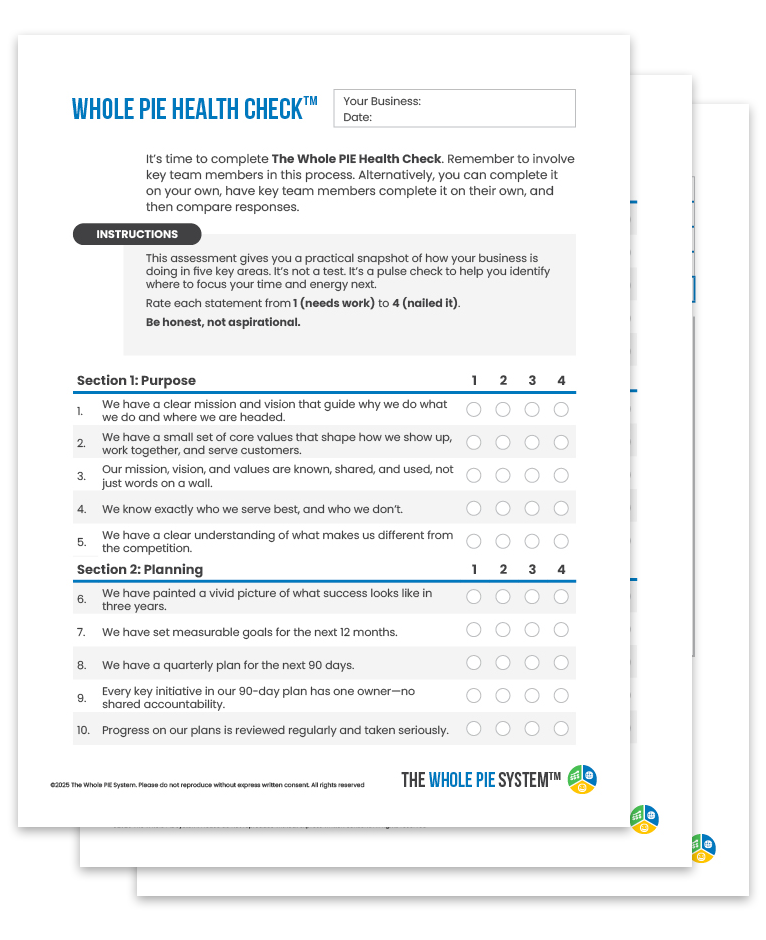
This is one of the reasons values are part of the Big Picture work we do in The Whole PIE System.
A clear vision tells you where you’re going. Your values help determine how you’re willing to get there—and, just as importantly, how you’re not.
Sometimes staying true to them will cost you money. Sometimes it will mean walking away from an opportunity, a customer, an employee, or even a market. Sometimes another business owner will look at your decision and think you’re nuts.
That’s okay.
If you abandon a supposed core value every time circumstances make it inconvenient, it was never really core in the first place.
Our decision to move from Canada to Costa Rica was unusually dramatic, but the principle behind it wasn’t. The circumstances around us – our market, in a broad sense – changed, and values that mattered deeply to us were put to the test.
Our values didn’t make the decision painless. They made the decision clear.
This Week’s Challenge
Take a look at the core values of your business and choose the one you believe is most important. Then ask yourself:
What is the last meaningful decision we made differently—or the last real cost we willingly accepted—because of this value?
If you can’t think of one, ask an even harder question:
Would we continue to hold this value if doing so put us at a competitive disadvantage?
Because the true test of a value isn’t whether you believe in it when it’s convenient. It’s whether you’re prepared to live by it when it isn’t.