Annual plans don’t fail because the goals are wrong. They fail because there’s no bridge between the goals and Tuesday morning.
Imagine a business that starts the year with a clear priority: improve customer retention. It makes perfect sense. Keeping more customers means more recurring revenue, better margins and less pressure to constantly replace the customers you’re losing.
Everyone agrees it’s important. It goes into the annual plan. Then everyone goes back to work. A major customer has an issue. Sales is chasing a big opportunity. Someone quits. The owner gets pulled into something that apparently only she can solve.
It’s now March, everyone has been incredibly busy, and very little has actually happened on customer retention.
So what went wrong?
It would be easy to say the company failed to execute its plan. I’d argue the problem happened earlier than that.
“Improve customer retention” was a perfectly good goal. But it never made the journey from something the business wanted to accomplish this year to something somebody was responsible for doing this week.
That’s a surprisingly long journey.
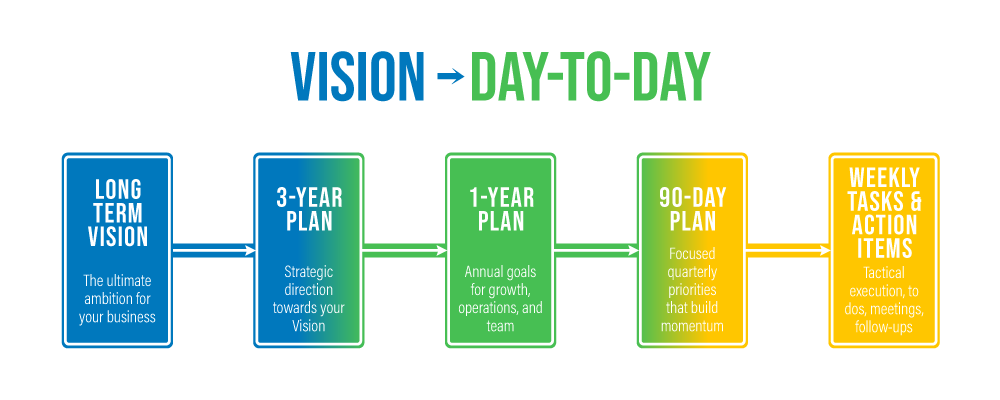
I use this graphic in Getting the Whole PIE to illustrate what I mean. The farther left you are, the easier it is to agree. We want to grow. We want happier customers. We want a stronger team. We want the business to depend less on the owner.
The farther right you move, the harder — and more important — it gets.
What specifically needs to happen this year? What needs to happen in the next 90 days? Who owns it? How will we know whether we’re making progress? And what, exactly, are we doing about it this week?
That’s where strategy becomes execution.
From “improve retention” to Tuesday morning
Let’s go back to our customer-retention goal. Suppose the annual goal is to increase customer retention from 80% to 90%. Now we have something measurable, but we’re still a long way from Tuesday morning.
For the next 90 days, the team decides it will introduce a proactive customer check-in process. One person owns the initiative. They identify the customers they’ll contact, create the process, and start tracking the number of check-ins completed and the issues uncovered.
Now imagine it’s Tuesday morning in February.
Someone on the team has five customer check-ins to complete that week. The number is on the company’s dashboard. Progress gets reviewed at the weekly meeting. If the check-ins aren’t happening — or they’re uncovering a recurring problem — there’s a place to talk about it and decide what to do.
The original goal hasn’t changed. The difference is that the plan has finally reached the week.
The missing middle
This is where I see a lot of business planning break down.
Business owners generally know what they want: more revenue, better margins, stronger people, happier customers, greater impact, less dependence on the owner, maybe even a little more enjoyment. You know, the Whole PIE 😉
The challenge is building the structure that connects those ambitions to what people actually do every day. That’s why a good annual plan isn’t enough. You also need clear 90-day priorities, clear ownership, the right metrics and a regular rhythm for reviewing progress and dealing with what’s getting in the way.
Otherwise, the urgent stuff will eventually win.
The Tuesday morning test
There’s a simple way to test this in your own business. Pick one of the most important goals in your current annual plan and follow it from left to right.
Can you clearly see how that goal translates into a 90-day priority? Does someone own it? Do you have a way to measure it? And if I walked into your business next Tuesday morning, could I see evidence that someone is actually doing something about it?
If the chain breaks somewhere along the way, you’ve probably found something worth fixing.
I’ve been thinking about this a lot lately because I’m getting ready to work with a small group of business owners on their 2027 game plans.
We’ll certainly spend time figuring out where they want their businesses to go next year. But we’ll spend just as much time building the bridge from that vision to the day-to-day: the first 90-day priorities, clear ownership, the right metrics and the meeting rhythm to keep everything moving.
Because I’m not particularly interested in helping someone create a beautiful 2027 plan that ends up sitting in a folder on their Google Drive. I’m much more interested in what happens on Tuesday morning.
This Week’s Challenge
Take one important goal from your 2026 plan and trace it all the way to this week.
Where does the chain break?
Fix that before you start planning 2027.