There’s a simple idea I come back to again and again with leadership teams, and it shows up in almost every business I work with. I call it the Hungry Horse Principle.
What happens when two people are responsible for feeding a horse?
The answer is simple. The horse doesn’t get fed.
Each person assumes the other one will do it. Each believes they are “involved,” but neither feels true ownership. The result isn’t shared responsibility. It’s no responsibility.
That’s what happens in businesses every day. A problem shows up, an opportunity sits there, or a decision needs to be made, and instead of one person driving it forward, two or more people are “responsible.” On paper, that sounds collaborative. In reality, it creates drift.
When everyone owns it, no one owns it.
A real world example: stuck in the mud
I saw this play out recently with a client dealing with a supplier of transaction processing hardware and software. The product wasn’t working as intended, and the fix required a new part to be manufactured, which meant coordination across multiple teams and organizations.
So they did what most companies do. They formed a working group with sales, operations, technical teams, subcontractors, and others, and set up regular Zoom calls to work through the issue.
On paper, it looked like progress. In reality, we were completely stuck.
Each update followed the same pattern. One person would suggest it belonged to another team, someone else would say they were waiting on a different group, and another would point to a subcontractor. There was plenty of activity, but no forward movement.
Everyone was involved, but no one was accountable.
The Brady Bunch moment
At a certain point, I paused the call and reframed the situation using the Hungry Horse Principle. I explained that the issue wasn’t a lack of effort or expertise. It was that multiple people were “responsible,” which meant no one truly was.
Then I said, “We need one person on the supplier side who owns this. One person who wakes up thinking about this problem and goes to bed thinking about this problem.”
“Who is it?”
What happened next looked like the opening grid from The Brady Bunch. People looked up, down, and sideways across their little box on the zoom screen, each silently hoping it wouldn’t be them. It was a light moment, but it perfectly illustrated the issue.
There was no clear owner.
What changed once ownership was clear
Eventually, we got alignment on one person who would own the project. Not coordinate it or contribute to it, but truly own the outcome and be responsible for driving it forward across all parties.
And almost immediately, things started to move. Decisions were made faster, communication became clearer, and the issue began progressing toward resolution in a way it hadn’t before.
Nothing else changed. The same people were involved, the same problem existed, and the same constraints were in place.
Just one difference: Clear ownership.
Why this is the first part of The Flywheel
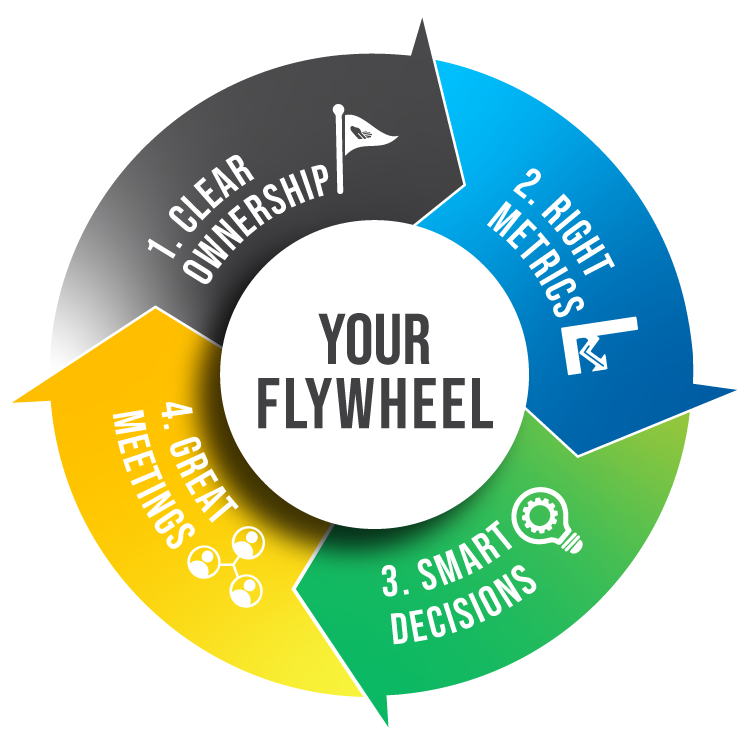
In The Whole PIE System™, Clear Ownership is the first of the four components of The Flywheel, and the story I just shared illustrates why. Before strategy, before metrics, and before great meetings, you need clarity on who owns what. Without that, everything else becomes harder than it needs to be.
You can have smart people, strong plans, and good intentions, but if ownership is shared, execution slows. Clear ownership is what turns intention into action and action into results.
Practical action steps you can take
If you want to get Clear Ownership working for you and your business, here are some practical action steps you can take this week:
- Look at where you are stuck. Identify the issues or initiatives that are dragging on longer than they should. These are often the areas where ownership is shared or unclear.
- Assign one owner. Not two people. Not a group. One person. They don’t have to do all the work, but they must own the outcome.
- Make it visible. Write ownership down and reinforce it in meetings so everyone knows who is accountable for each priority.
- Test for real ownership. Ask yourself: if this fails, does one person feel it in their gut? If the answer is no, you still have shared ownership, and that usually means no ownership.
Final thought
If two people are responsible for feeding a horse, the horse doesn’t get fed.
Nobody wants a hungry horse in their business.
Clarify the owner of each priority. Then feed the horse, and feed your growth.
Andy